
By Dr. Dixit Kumar Thakur
| “The most common thing I hear from new patients at Pulmovista Clinics is: ‘I’ve had allergies for years but no one has ever tested me.’ They’ve been given antihistamines, nasal sprays, inhalers — sometimes all three — without anyone ever identifying what they’re actually allergic to. Finding the hidden trigger is not a luxury. It’s the foundation of every effective allergy treatment plan I build.” — Dr. Dixit Kumar Thakur, Senior Pulmonologist & Allergy Specialist, Pulmovista Clinics, South Delhi |
I am Dr. Dixit Kumar Thakur, Senior Pulmonologist and Allergy Specialist at Pulmovista Clinics, South Delhi. In over 13 years of clinical practice, I have tested thousands of patients for allergies — and without exception, the allergy testing process changes something fundamental about their understanding of their condition and their path to effective treatment.
Allergy — whether it manifests as allergic rhinitis (hay fever), allergic asthma, atopic dermatitis, food allergy, or anaphylaxis — is always triggered by something specific. The sneezing, the wheeze, the itching eyes, the chronic cough: these are not random events. They are the immune system’s response to a specific allergen — a substance it has been incorrectly taught to treat as an enemy. And until you know which specific substance is causing the response, every treatment you use is guesswork.
In South Delhi — a region with one of the highest urban allergen loads in India, combining dust mite populations amplified by monsoon humidity, Prosopis pollen from thousands of roadside trees, year-round Aspergillus mould spores, and cockroach allergens in older residential and commercial buildings — the allergy trigger landscape is complex, year-round, and frequently misunderstood. This guide explains exactly how I identify your hidden triggers at Pulmovista Clinics, what the allergy testing process involves, and what we can do once we have found the cause.
1. Why ‘Hidden’ Triggers Are So Common in South Delhi
The word ‘hidden’ in this guide’s title is deliberate — because the allergens that cause the most chronic, debilitating allergic disease in South Delhi are not the obvious ones. They are not the spectacular pollen clouds of spring or the dramatic Diwali smoke. They are the invisible, year-round, indoor-and-outdoor allergens that patients are exposed to every single day — so constantly that they have stopped associating them with their symptoms.
Why South Delhi Creates a Unique and Complex Allergen Environment
• Dense residential housing with older construction: South Delhi’s mix of older DDA flats, bungalows, and commercial premises creates ideal breeding conditions for house dust mites — the most prevalent indoor allergen globally. Carpets, upholstered sofas, mattresses, and pillows in older homes harbour dust mite populations that would not be tolerated in newer, better-ventilated buildings.
• Monsoon humidity amplifying indoor allergens: South Delhi’s enclosed valleys trap humidity during monsoon — creating optimal conditions for mould growth and dust mite proliferation simultaneously. July to September sees indoor allergen loads peak dramatically.
• Prosopis juliflora roadside trees: The invasive mesquite tree lines hundreds of kilometres of South Delhi’s roads, parks, and colony boundaries. It pollinates heavily from February to May — producing highly allergenic pollen that is among the most underestimated allergen sources in Delhi NCR. Many South Delhi residents with spring allergy symptoms have never been tested for Prosopis sensitivity.
• Cockroach populations in residential buildings: Cockroach droppings are a potent, year-round indoor allergen — particularly significant in apartment buildings, older colonies, and homes with below-ground storage or kitchen areas. Many patients at Pulmovista present with cockroach-driven allergic asthma that has been treated as generic ‘house dust’ allergy for years.
• Aspergillus and mould from construction and water damage: South Delhi’s ongoing construction activity and the frequency of seepage and water damage in older buildings creates extensive mould growth — with Aspergillus niger and Alternaria alternata being the most clinically significant species for allergic respiratory disease.
| “When I take a detailed residential history from South Delhi patients at Pulmovista — which colony they live in, what type of building, whether they have carpets or AC units, whether there is visible dampness, whether they keep plants indoors — I often already have a provisional diagnosis before any test is done. South Delhi’s allergy landscape has a very specific geography that 13 years of practice here has taught me to read.” — Dr. Dixit Kumar Thakur, Pulmovista Clinics, South Delhi |
2. The Big Three: Dust Mites, Pollen, and Mould — South Delhi’s Most Common Hidden Triggers
Hidden Trigger 1: House Dust Mites — The Year-Round Indoor Enemy
House dust mites (Dermatophagoides pteronyssinus and D. farinae) are microscopic arachnids — too small to see with the naked eye — that live in mattresses, pillows, bedding, upholstered furniture, carpets, and soft toys. They feed on shed human skin cells and thrive in warm, humid environments. In South Delhi’s humid climate, dust mite populations are among the highest of any urban environment in India.
It is not the mite itself that causes allergy — it is the proteins in mite faecal particles and body fragments that are the allergens. These particles become airborne when bedding is disturbed, when walking on carpet, or when turning over a mattress — being inhaled directly into the airways where they trigger IgE-mediated allergic responses in sensitised patients.
| Dust Mite Allergy — Key Facts | Clinical Relevance at Pulmovista Clinics |
| Most common indoor allergen globally | Responsible for the majority of allergic asthma and perennial allergic rhinitis in South Delhi patients |
| Worst months: July–October | Monsoon humidity dramatically increases mite reproduction — symptoms typically worsen from July and peak in September-October |
| Location: Mattress, pillows, sofa | The bedroom is the highest-exposure environment — 8 hours of sleep = 8 hours of mite allergen exposure |
| Diagnosis: Skin prick test or specific IgE (RAST) | Tested routinely at Pulmovista Clinics — positive test confirms sensitisation; clinical history confirms relevance |
| Treatment: Avoidance + immunotherapy | Anti-mite mattress and pillow encasements; HEPA filtration; allergen immunotherapy to modify the underlying allergy |
Hidden Trigger 2: Pollen — Which Pollens Are Silently Driving Your Symptoms
South Delhi has a complex and underappreciated pollen calendar that drives year-round allergic disease across multiple seasons. Most patients know about ‘hay fever season’ in a general sense — but very few know which specific pollen is causing their symptoms, which is essential information for timing antihistamines, planning outdoor activities, and selecting the right allergen for immunotherapy.
| Pollen / Season | Peak Months in South Delhi | Key Clinical Features |
| Prosopis juliflora (Mesquite) | February–May (peak: April) | Highly allergenic; lines South Delhi roads; most underdiagnosed pollen allergy in NCR; causes asthma, rhinitis, conjunctivitis |
| Parthenium hysterophorus (Congress Grass) | August–November | Invasive weed; extremely potent allergen; causes contact dermatitis AND respiratory allergy; very common in South Delhi parks and roadsides |
| Grass pollens (Cynodon, Poa) | April–June and August–October | Two seasonal peaks; wide distribution; common sensitiser in children who play outdoors in South Delhi parks |
| Eucalyptus | January–March | Lines many South Delhi colony boundaries; moderate allergenic potency; early spring rhinitis trigger |
| Cassia (Amaltas) | April–May | The yellow-flowering tree common in South Delhi’s residential colonies; peaks just before monsoon |
| Morus (Mulberry) | February–April | Early spring; highly allergenic; causes severe rhinitis and conjunctivitis in sensitised patients |
Hidden Trigger 3: Mould — The Trigger That Changes with the Monsoon
Mould spores are one of the most underappreciated allergen sources in South Delhi — and one of the most clinically significant for patients with asthma. Unlike pollen, which has clear seasonal peaks, mould is a year-round allergen with a dramatic amplification during and after the monsoon.
• Alternaria alternata: The most clinically important outdoor mould allergen in India. Alternaria sensitisation is strongly associated with severe asthma — including thunderstorm asthma events, which occur when storms rupture mould spore clusters. Peaks July–October in South Delhi.
• Aspergillus species: Found in soil, decaying organic matter, construction debris, and damp indoor walls. Aspergillus sensitisation in asthma patients can cause ABPA (Allergic Bronchopulmonary Aspergillosis) — a serious complication that requires specialist management at Pulmovista Clinics.
• Cladosporium: The most abundant outdoor mould in South Delhi’s air — present year-round with peaks in warm, humid conditions. Common cause of perennial allergic rhinitis.
• Indoor moulds (Penicillium, Mucor): Found in bathroom grouting, AC drain pans, potted plant soil, and water-damaged walls. These species cause year-round indoor allergy symptoms that patients consistently attribute to ‘dust’ — because the seasonal pattern is absent.
3. Beyond the Big Three: Other Hidden Triggers I Test for at Pulmovista Clinics
Dust mites, pollens, and moulds account for the majority of allergic disease in South Delhi — but they are not the only triggers I identify at Pulmovista Clinics. A complete allergy workup for a South Delhi patient also considers:
Cockroach Allergens
Cockroach droppings and body parts are a major indoor allergen that is dramatically underdiagnosed across India — in part because patients are embarrassed to mention cockroach presence, and in part because clinicians rarely ask. In South Delhi’s residential buildings — particularly older DDA housing, commercial kitchens, and below-ground storage areas — cockroach populations are substantial, and cockroach allergen levels in settled dust can be extremely high.
Cockroach sensitisation is particularly strongly associated with allergic asthma in urban Indian populations — some studies suggest it is more prevalent than dust mite sensitisation in certain South Delhi demographic groups. I test for Blattella germanica (German cockroach) and Periplaneta americana (American cockroach) allergen-specific IgE in all South Delhi patients with perennial allergic asthma or rhinitis, particularly those living in apartments or older housing.
Pet Dander — Cat and Dog Allergens
Pet ownership has increased significantly across South Delhi’s middle and upper-middle class residential areas over the past decade. Cat allergen (Fel d 1) is particularly insidious because it is extremely lightweight — it remains airborne for hours and clings to clothing, meaning non-pet-owners can be significantly exposed simply by visiting a home with cats or sitting on public transport with a pet owner.
Pet dander allergy is frequently missed in South Delhi patients because the allergy develops gradually over months to years of exposure — the patient has grown up with the pet and cannot conceive of being allergic to it. I see this pattern regularly at Pulmovista: a patient with worsening year-round asthma who acquired a pet 18 months ago and insists their pet cannot be the cause ‘because they have always had pets.’
Food Allergens with Respiratory Cross-Reactivity
• Latex-fruit syndrome: Allergy to latex cross-reacts with banana, avocado, kiwi, and chestnut — relevant in South Delhi’s healthcare workers and patients with frequent medical procedures.
• Oral allergy syndrome: Patients with pollen allergy develop tingling or swelling in the mouth when eating certain raw fruits and vegetables — because pollen proteins cross-react with similar proteins in food. Prosopis-sensitised patients may react to certain legumes; grass pollen-sensitised patients may react to raw tomatoes and celery.
• Wheat and cereal allergens: Occupational wheat allergy (baker’s asthma) — relevant in South Delhi’s food service industry workers.
Occupational Allergens Specific to South Delhi
South Delhi’s economy includes significant numbers of workers in healthcare (AIIMS and multiple private hospitals in the vicinity), chemical and pharmaceutical industries, construction, catering, and small manufacturing. Occupational allergens I test for in appropriate patients include:
• Latex (healthcare workers): Immediate IgE-mediated reactions to latex gloves — causes rhinitis, urticaria, and asthma in sensitised healthcare workers.
• Isocyanates (vehicle paint, construction materials): One of the most common causes of occupational asthma globally — relevant in South Delhi’s many automotive workshops.
• Flour dust (bakeries, catering): Baker’s asthma — IgE-mediated sensitisation to wheat, rye, and fungal amylase.
• Chemical sensitisers (cleaning agents, hair dyes): Reactive airway dysfunction from repeated low-level chemical exposure — common in South Delhi’s domestic workers and salon employees.
4. The Allergy Testing Process at Pulmovista Clinics: How the Best Allergy Doctor in South Delhi Finds Your Trigger
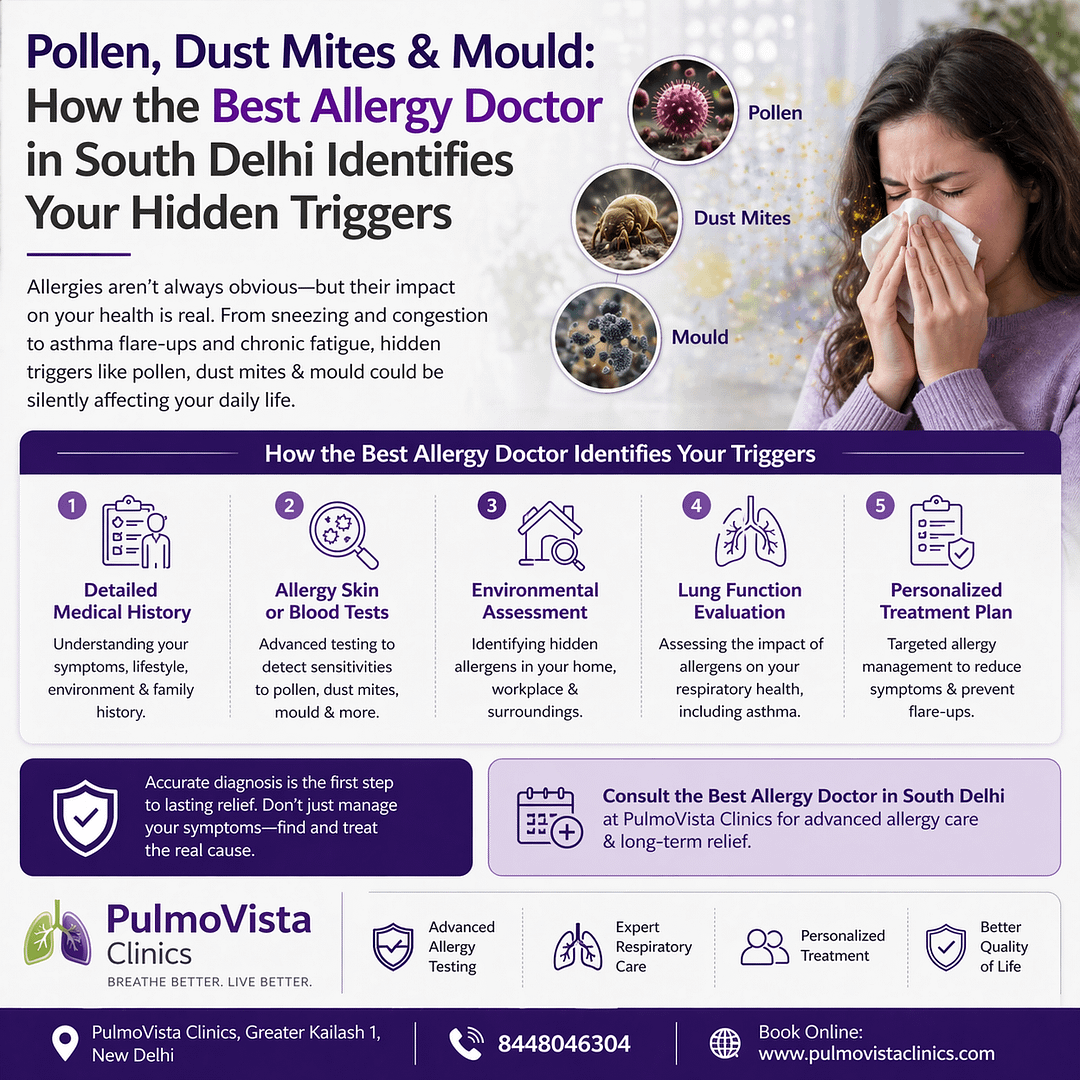
Finding your hidden trigger is not guesswork. At Pulmovista Clinics, I follow a structured, evidence-based allergy testing protocol that combines clinical history, objective testing, and clinical interpretation to identify the specific allergen — or allergens — driving your disease. As the best allergy doctor in South Delhi, my testing process is comprehensive, not generic. Here is exactly what it involves:
Step 1: Detailed Allergy History — The Foundation of Everything
Before a single test is ordered, I spend 20–30 minutes taking a detailed allergy history. The history alone often narrows the differential significantly — and it tells me exactly which tests to order rather than applying a generic panel to every patient. I ask about:
• Symptom pattern: Seasonal vs. perennial (year-round)? Intermittent vs. persistent? Time of day? Indoor vs. outdoor predominance?
• Residential environment: Colony, building type, floor level, AC system, carpets or rugs, visible dampness or mould, pets, plants, pest presence.
• Occupational environment: Specific exposures at work — dust, chemicals, animals, flour, latex.
• Trigger associations: Does visiting a specific place improve or worsen symptoms? Do symptoms worsen after specific activities — gardening, cleaning, making the bed?
• Family history: First-degree relatives with asthma, allergic rhinitis, eczema, or food allergy — the atopic triad runs in families.
• Previous allergy testing: What has been tested before, and what were the results? I frequently find that previous testing was incomplete or misinterpreted.
Step 2: Skin Prick Testing (SPT) — The Gold Standard
Skin prick testing is the most widely used, most evidence-supported, and most cost-effective allergy test available. At Pulmovista Clinics, SPT is performed by trained allergy nurses under my direct supervision, with full emergency anaphylaxis management on-site.
The process: Small drops of standardised allergen extracts are placed on the forearm at 2cm intervals. A lancet device is used to create a tiny prick through each drop — allowing a microscopic quantity of allergen to enter the skin. After 15–20 minutes, the size of the wheal (raised bump) at each prick site is measured. A wheal of 3mm or more than the negative control indicates IgE-mediated sensitisation to that allergen.
| 🔬 Allergens Routinely Tested by Skin Prick Test at Pulmovista Clinics, South Delhi Indoor allergens: House dust mite (D. pteronyssinus and D. farinae), German cockroach, American cockroach, cat dander, dog dander Outdoor pollens: Prosopis juliflora, Parthenium hysterophorus, Cynodon dactylon (Bermuda grass), Poa annua, Eucalyptus, Morus (mulberry), Cassia siamea Moulds: Alternaria alternata, Aspergillus fumigatus, Aspergillus niger, Cladosporium herbarum, Penicillium notatum Foods (when indicated): Groundnut/peanut, tree nuts, milk, egg, wheat, soybean, fish, shellfish Occupational (when indicated): Latex, wheat flour, isocyanates, formaldehyde Positive control: Histamine (confirms reactive skin); Negative control: Saline (rules out dermatographism) |
Step 3: Specific IgE Blood Testing (RAST/ImmunoCAP) — When SPT Needs Support
Specific IgE blood testing — also known as RAST (RadioAllergoSorbent Test) or ImmunoCAP — measures the level of IgE antibodies to specific allergens in the blood. At Pulmovista Clinics, I use specific IgE testing in the following situations:
• When SPT cannot be performed: Severe eczema or dermatographism making SPT uninterpretable; antihistamines that cannot safely be stopped; patients on beta-blockers where adrenaline cannot be safely used in anaphylaxis management.
• When SPT results require quantification: A specific IgE level (expressed in kU/L) provides a quantitative measure of sensitisation that helps predict clinical reactivity and monitor response to immunotherapy.
• For component-resolved diagnosis: Modern specific IgE testing can identify allergy to individual protein components within a complex allergen — distinguishing true allergy from cross-reactivity and predicting anaphylaxis risk more precisely than whole-extract testing.
• For ABPA diagnosis: Total serum IgE and Aspergillus-specific IgE and precipitins — essential for diagnosing Allergic Bronchopulmonary Aspergillosis in patients with asthma and recurrent lung infiltrates.
Step 4: Lung Function Testing — Confirming the Respiratory Impact
At Pulmovista Clinics, allergy testing is never done in isolation from respiratory assessment. Every patient with suspected or confirmed allergic respiratory disease undergoes:
• Spirometry with bronchodilator reversibility: Confirming whether allergic rhinitis has progressed to allergic asthma — critically important because untreated allergic rhinitis significantly increases asthma risk over time.
• FeNO (Fractional Exhaled Nitric Oxide): Quantifying eosinophilic airway inflammation — the hallmark of allergic asthma. Elevated FeNO alongside positive allergy tests is the most compelling evidence base for ICS therapy and allergen immunotherapy.
• Peak flow monitoring: Identifying occupational or allergen-specific patterns of airflow variability that confirm the link between the identified allergen and the respiratory symptoms.
Step 5: Challenge Tests — When Diagnosis Remains Uncertain
When allergy testing results and clinical history do not align clearly, or when a specific allergen needs to be confirmed as clinically relevant rather than merely sensitising, I use bronchial or nasal provocation testing — carefully controlled, medically supervised allergen exposure challenges conducted at Pulmovista Clinics with full monitoring and resuscitation equipment available.
5. Interpreting Your Results: What Positive and Negative Tests Actually Mean
One of the most important — and most frequently misunderstood — aspects of allergy testing is result interpretation. A positive allergy test does not automatically mean you are allergic in a clinically significant way. And a negative test does not automatically mean the allergen is not contributing to your symptoms. This is why allergy testing at Pulmovista Clinics is always interpreted by Dr. Dixit Kumar Thakur in the context of your full clinical history — never in isolation.
| Test Result | What It Means — Dr. Dixit Kumar Thakur’s Interpretation Framework |
| Positive SPT / elevated specific IgE | Confirms IgE-mediated sensitisation to the tested allergen. Clinical relevance requires correlation: does exposure to this allergen coincide with your symptoms? A positive test to an allergen you are never exposed to may not be clinically significant. |
| Negative SPT and specific IgE | Makes IgE-mediated allergy to the tested allergen unlikely — but does not exclude non-IgE allergy, irritant reactions, or allergy to untested allergens. Clinical history guides what to test next. |
| Multiple positive tests | Polysensitisation — allergy to multiple allergens — is common in South Delhi patients with year-round high allergen loads. Requires careful prioritisation: which allergen is driving the most significant disease? Immunotherapy targets are selected based on clinical relevance, not just test result magnitude. |
| Positive test + no clinical history of exposure | May represent asymptomatic sensitisation — the immune system has ‘learned’ to recognise the allergen but has not yet been exposed enough to produce clinical symptoms. Indicates future risk: avoiding the allergen is prudent even without current symptoms. |
| Positive test to food allergen with respiratory symptoms | May indicate pollen-food cross-reactivity (oral allergy syndrome) or true food-triggered respiratory allergy. Component-resolved testing and careful clinical history required to distinguish — managed at Pulmovista Clinics. |
6. What Happens After We Find Your Trigger: Treatment Options at Pulmovista Clinics
Finding the hidden trigger is the diagnostic achievement. What follows is the therapeutic opportunity — and in allergy medicine, the treatment options available once the trigger is identified are among the most effective in all of medicine. Here is what I offer at Pulmovista Clinics once your allergen has been confirmed:
Step 1: Allergen Avoidance — Reducing the Trigger Load
The most immediately actionable intervention is allergen avoidance — reducing exposure to the identified trigger as much as practically possible. Avoidance does not cure allergy, but it reduces the total allergen load on the immune system, decreasing the frequency and severity of reactions and improving the effectiveness of medications. At Pulmovista Clinics, I provide personalised, specific avoidance guidance based on the identified trigger:
| Identified Trigger | Dr. Dixit Kumar Thakur’s Avoidance Protocol at Pulmovista |
| House dust mite | Anti-mite mattress and pillow encasements (impermeable covers); wash bedding at ≥60°C weekly; remove carpets from bedroom; HEPA air purifier in bedroom; maintain indoor humidity below 50% with dehumidifier during monsoon; vacuum with HEPA-filter vacuum cleaner |
| Prosopis / Grass pollen | Monitor pollen forecasts; keep windows closed on high-pollen mornings (peak: 6am–10am); wear sunglasses outdoors; shower and change clothes after outdoor exposure; avoid outdoor exercise during peak season; use air recirculation in car AC |
| Alternaria / Aspergillus mould | Dehumidify indoor spaces to <50%; fix all water leaks and seepage immediately; clean bathroom grouting and AC drain pans monthly; avoid composting or gardening in damp soil during monsoon; remove indoor potted plants from bedroom |
| Cockroach | Seal kitchen entry points; store food in airtight containers; clean food preparation surfaces immediately after use; professional pest control; do not leave standing water; address rubbish management in building common areas |
| Cat / Dog dander | If pet rehoming is not possible: ban pet from bedroom entirely; use HEPA purifier in bedroom; wash hands after pet contact; regular vacuuming with HEPA filter; wash pet bedding weekly; consider immunotherapy to reduce reaction severity |
| Occupational allergen | Workplace exposure control — PPE, ventilation, substitution of sensitising agent; occupational health referral; in some cases, change of workplace role or formal medical advice on fitness for continued role |
Step 2: Pharmacological Treatment — Right Medication for Right Trigger
Once the trigger is identified, medication selection becomes far more targeted and effective. At Pulmovista Clinics, pharmacological treatment is selected based on the specific trigger, the organ system affected, and the severity of the allergic response:
• Intranasal corticosteroids: First-line for allergic rhinitis — most effective for perennial (year-round, dust mite / cockroach) disease. Dosed consistently, not just on symptomatic days.
• Non-sedating antihistamines: First-line for intermittent allergic rhinitis — particularly seasonal pollen allergy. Started 2 weeks before the anticipated pollen season begins at Pulmovista.
• SMART therapy (ICS-formoterol): GINA 2026 preferred strategy for allergic asthma — combined controller and rescue in a single inhaler, with every rescue puff also delivering anti-inflammatory ICS.
• Montelukast (LTRA): Particularly useful in the pollen-rhinitis-asthma overlap — addresses both nasal and bronchial components through the leukotriene pathway.
• Omalizumab (Xolair) biologic: For patients with severe allergic asthma where the trigger has been confirmed but cannot be avoided and standard medications are insufficient — anti-IgE biologic therapy blocks the IgE antibody that drives allergic reactions. Available at Pulmovista Clinics.
• Adrenaline auto-injector (EpiPen): Prescribed and trained at Pulmovista for patients at risk of anaphylaxis — food allergy, insect venom allergy, latex allergy. Written anaphylaxis action plan provided.
Step 3: Allergen Immunotherapy — The Only Disease-Modifying Allergy Treatment
Allergen immunotherapy (AIT) is the only treatment available for allergy that actually modifies the underlying immune response — rather than simply suppressing symptoms. Over a 3–5 year course of treatment, AIT progressively desensitises the immune system to the identified allergen — reducing symptom severity, decreasing medication requirements, preventing new allergen sensitisations, and in some cases achieving long-term remission even after the treatment course ends.
At Pulmovista Clinics, I offer both forms of AIT:
• Subcutaneous Immunotherapy (SCIT — Allergy Shots): Monthly injections of progressively increasing allergen doses — administered at Pulmovista with a 30-minute observation period. The most evidence-supported form for respiratory allergy. Available for dust mite, pollen, mould, and cockroach allergens.
• Sublingual Immunotherapy (SLIT — Drops or Tablets): Daily allergen drops or tablets placed under the tongue — taken at home after the first dose is given at Pulmovista. More convenient than SCIT; strong evidence for house dust mite and grass pollen. Particularly suitable for patients with needle anxiety, children, and patients who cannot attend monthly clinic visits.
| Allergen | Immunotherapy Eligibility at Pulmovista Clinics |
| House dust mite | Strong evidence — SCIT and SLIT both effective; first-choice immunotherapy for South Delhi’s most prevalent allergen |
| Prosopis juliflora pollen | SCIT available at Pulmovista for confirmed Prosopis-sensitised patients — particularly relevant for South Delhi residents along heavily tree-lined roads |
| Grass pollens (Cynodon, Poa) | SCIT and SLIT both available; strong evidence for allergic rhinitis and asthma |
| Alternaria mould | SCIT available; particularly important for severe asthma with Alternaria sensitisation |
| Cockroach | SCIT available for confirmed cockroach-sensitised patients with significant clinical disease |
| Cat / Dog dander | SCIT available; discussed carefully with patients who cannot or will not rehome pets |
7. Why South Delhi Patients Choose Pulmovista Clinics as the Best Allergy Doctor in South Delhi
Patients across South Delhi — from Vasant Vihar and Safdarjung to Greater Kailash, Defence Colony, Hauz Khas, and Saket — come to Pulmovista Clinics as their preferred allergy specialist because of the depth, precision, and clinical completeness of the allergy assessment and treatment I provide. As the best allergy doctor in South Delhi, here is what distinguishes my approach at Pulmovista:
1. Comprehensive South Delhi-specific allergy panel: My standard skin prick test panel at Pulmovista is specifically calibrated to South Delhi’s allergen landscape — including Prosopis juliflora, Parthenium, cockroach species prevalent in this region, and local mould species. Not a generic national panel.
2. Integrated pulmonology and allergy expertise: As a senior pulmonologist, I assess allergic rhinitis always in the context of its lower airway impact — because 30–40% of allergic rhinitis patients have comorbid asthma, and treating only the nose while the bronchi are inflamed produces incomplete results. Spirometry, FeNO, and allergy testing are done together at Pulmovista — not sequentially across multiple specialists.
3. On-site allergy testing with emergency cover: Skin prick testing at Pulmovista Clinics is performed in a fully equipped clinical environment with trained staff and anaphylaxis management on site. Patients never undergo allergy testing without full emergency preparedness.
4. Both SCIT and SLIT immunotherapy: Many allergy clinics in South Delhi offer one or neither form of allergen immunotherapy. Pulmovista offers both — allowing me to select the most appropriate form for each patient’s allergen profile, lifestyle, and treatment preferences.
5. Biologic therapy for severe allergic disease: For patients with severe allergic asthma that has not responded adequately to standard medications and allergen avoidance, Omalizumab (anti-IgE biologic therapy) is available at Pulmovista Clinics — prescribed after a full biomarker assessment including total IgE, allergen-specific IgE, and FeNO.
6. Written personalised allergy management plan: Every Pulmovista allergy patient leaves with a written plan — identified triggers, personalised avoidance advice, medication schedule, immunotherapy programme details (where applicable), and emergency action plan for anaphylaxis risk patients.
7. Long-term relationship and follow-up: Allergy management — particularly immunotherapy — is a multi-year commitment. At Pulmovista Clinics, I maintain long-term relationships with allergy patients, monitoring sensitisation patterns, adjusting treatment as the allergen landscape and the patient’s life circumstances change, and ensuring that the investment in allergen immunotherapy is protected by consistent follow-up.
Conclusion: Hidden Triggers Don’t Have to Stay Hidden — Pulmovista Clinics Can Find Them
If you have been living with year-round sneezing, a chronic cough, persistent breathlessness, or recurrent allergic reactions — and you have never had a comprehensive allergy test — you have been managing symptoms without knowing their cause. In South Delhi, where the allergen landscape is complex, year-round, and often invisible, that gap between symptom and cause is the single biggest barrier to effective treatment.
At Pulmovista Clinics, Dr. Dixit Kumar Thakur has built a comprehensive allergy and respiratory medicine service specifically calibrated to South Delhi’s allergen environment — with the diagnostic tools, the clinical expertise, and the treatment options to identify your hidden trigger and address it systematically. Whether the answer turns out to be dust mites in your bedroom, Prosopis pollen from the trees on your road, Aspergillus from the damp wall in your bathroom, or cockroach allergen from your building’s kitchen — finding it changes everything.
Once we know the cause, we can treat the cause. And treating the cause — not just suppressing the symptoms — is what lasting allergy relief looks like.
FAQs-Allergy Testing and Treatment in South Delhi
- How long does allergy testing take at Pulmovista Clinics and does it hurt?A complete allergy assessment at Pulmovista Clinics — including history, skin prick testing, spirometry, and FeNO — typically takes 90–120 minutes in total. The skin prick test itself is not painful in the way a conventional injection is — the lancet creates a very superficial prick, similar in sensation to a firm press with a fingernail. The test results are readable within 20 minutes. Patients may experience local itching at positive test sites — this is the expected immune response and resolves within an hour. Severe allergic reactions to the SPT are extremely rare and are managed immediately if they occur at Pulmovista.
- Do I need to stop antihistamines before my allergy test?Yes — antihistamines suppress the skin response to allergen testing and can produce false-negative results. Short-acting antihistamines (loratadine, cetirizine, fexofenadine) should be stopped for at least 3–5 days before skin prick testing. Longer-acting antihistamines may need to be stopped for up to 7 days. Nasal steroid sprays, asthma inhalers, and montelukast do NOT need to be stopped before allergy testing. Please inform Dr. Dixit Kumar Thakur at Pulmovista about all medications you are taking when booking your appointment, so appropriate preparation instructions can be given.
- I tested positive for dust mite allergy but I have no carpets and clean my home regularly. How can this be?Dust mite allergy is one of the most counterintuitive diagnoses for patients to accept — because the allergen is invisible and does not correlate with visible cleanliness. House dust mites live primarily in mattresses, pillows, and upholstered furniture — not on floors. A spotlessly clean home with a 10-year-old mattress and non-encased pillows can have extremely high dust mite allergen levels. The solution is targeted interventions — anti-mite mattress and pillow encasements, bedding washed at ≥60°C weekly, and a HEPA air purifier in the bedroom — rather than general cleaning. Dr. Dixit Kumar Thakur provides specific, practical avoidance guidance at Pulmovista for every identified trigger.
- How long does allergen immunotherapy take and is it worth it?Allergen immunotherapy (SCIT or SLIT) is a 3–5 year treatment. The build-up phase (progressively increasing doses) typically takes 3–6 months, followed by a maintenance phase with stable monthly doses (SCIT) or daily sublingual doses (SLIT) for 3–5 years in total. The evidence is clear: patients who complete the full course achieve significant, sustained reduction in allergy symptoms and medication requirements — with benefits that persist for years after completing treatment. For patients with moderate-to-severe allergic rhinitis or allergic asthma driven by a specific allergen, immunotherapy is the most cost-effective long-term treatment available. At Pulmovista Clinics, I discuss the commitment and expected outcomes with every patient before initiating AIT.
- Can children undergo allergy testing and immunotherapy at Pulmovista Clinics?Yes. Skin prick testing is safe and well-tolerated from age 2 onwards — and is particularly valuable in children because early identification of allergens allows early avoidance and immunotherapy initiation, which may reduce the progression from allergic rhinitis to asthma (the atopic march). Sublingual immunotherapy (SLIT drops) is particularly suitable for children because it is administered at home without injections. At Pulmovista Clinics, I have extensive experience with paediatric allergy assessment and management — with age-appropriate testing panels and child-friendly consultation approaches. I provide written allergy action plans specifically formatted for school nurses and parents.