
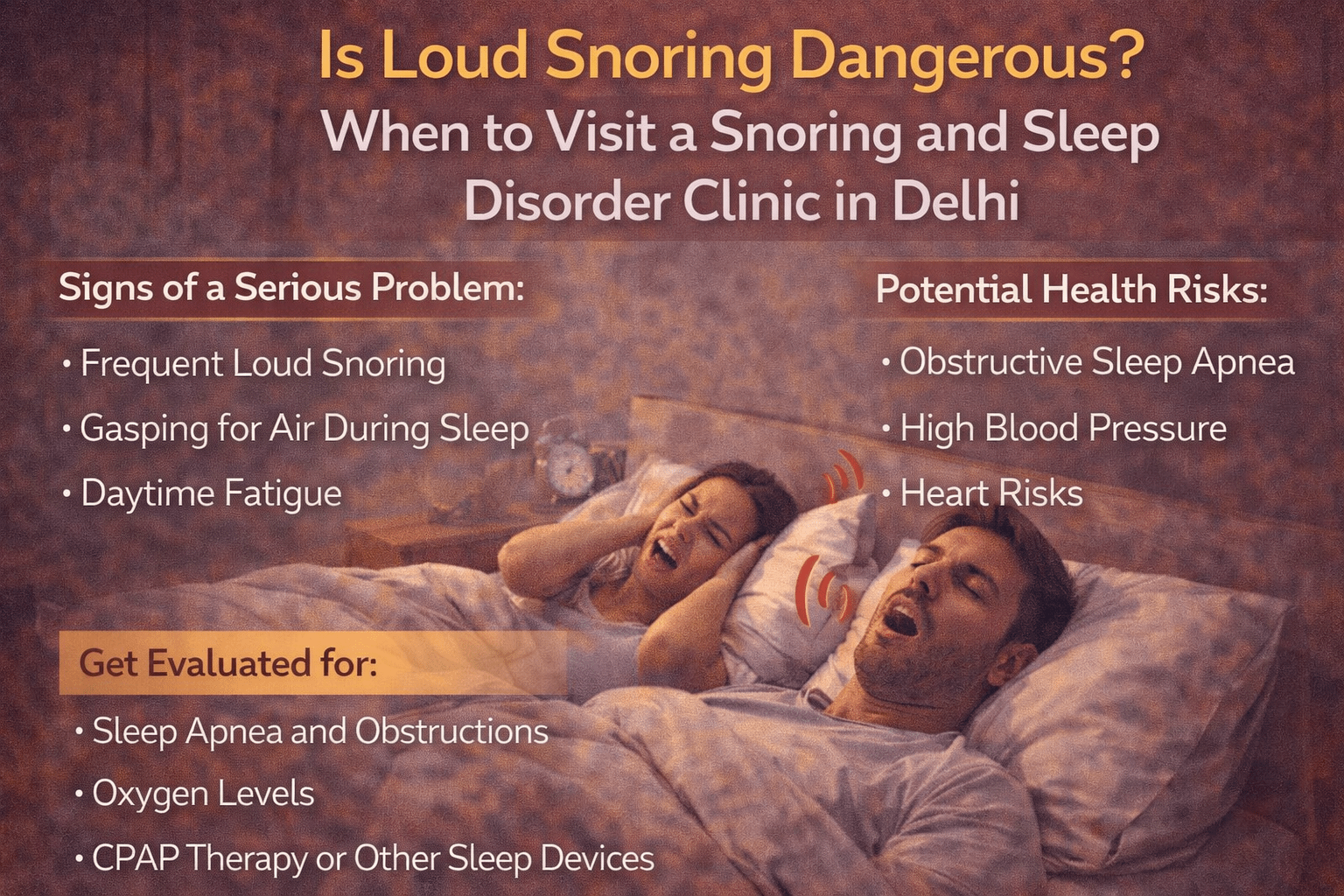
Most of us have either been the person snoring or the person lying awake next to them, staring at the ceiling. It is easy to dismiss snoring as a minor inconvenience — something funny to joke about at breakfast. But if the snoring in your household is loud, persistent, and accompanied by gasping, pauses in breathing, or extreme daytime tiredness, it is time to take it seriously. At Pulmovista Clinics, Dr. Dixit Kumar Thakur sees patients every week who have been putting up with sleep-disrupting symptoms for years before finally walking through the door. The good news is that help is available — and getting it sooner makes a real difference.
What Is Snoring, Really?
Snoring happens when the flow of air through your mouth and nose is partially blocked during sleep. The soft tissues in your throat — the soft palate, uvula, and tongue — relax and partially collapse inward, causing vibration as air pushes past. That vibration is the sound you hear.
Occasional, light snoring after a long day or after consuming alcohol is not usually cause for alarm. However, habitual loud snoring is a different matter. It can be a red flag pointing to an underlying condition that affects your breathing, your oxygen levels, and ultimately your heart, brain, and overall health.
When Snoring Becomes Dangerous: The Sleep Apnea Connection
The most important reason to take loud snoring seriously is its association with obstructive sleep apnea (OSA) — a condition in which the airway collapses completely during sleep, causing breathing to stop repeatedly throughout the night. These pauses can last anywhere from a few seconds to more than a minute and may happen dozens or even hundreds of times per night.
Each time breathing stops, your brain sends an emergency signal to wake you just enough to reopen the airway. You may not even remember these micro-awakenings, but they completely shatter the quality of your sleep. Over time, untreated sleep apnea is linked to:
- High blood pressure — the repeated oxygen drops trigger your body’s stress response night after night
- Heart disease and irregular heartbeats — the cardiovascular system bears an enormous burden
- Type 2 diabetes — poor sleep disrupts blood sugar regulation
- Stroke — the risk is significantly elevated in people with untreated OSA
- Depression and anxiety — chronic sleep deprivation takes a serious toll on mental health
- Accidents — drowsy driving and workplace errors are far more common among people with untreated sleep apnea
This is why snoring is never “just snoring.” If the person sleeping next to you sounds like they are choking, gasping, or stopping and restarting their breathing — or if you yourself wake up with headaches, a dry mouth, and exhaustion no matter how many hours you slept — these are warning signs that need professional evaluation.
Signs You Should Not Ignore
Dr. Dixit Kumar Thakur at Pulmovista Clinics advises patients to pay attention to the full picture, not just the snoring sound. Here are the symptoms that should prompt you to look up sleep apnea treatment near me and book an appointment without delay:
- Loud snoring that can be heard through closed doors
- Witnessed pauses in breathing during sleep
- Waking up gasping or choking
- Unrefreshing sleep — waking up tired despite a full night in bed
- Severe daytime sleepiness, even while sitting still or driving
- Difficulty concentrating or memory problems
- Frequent morning headaches
- Irritability, mood swings, or depression
- Frequent nighttime urination
- Dry mouth or sore throat upon waking
- Restless, tossing-and-turning sleep
In children, symptoms can look different — bedwetting, behavioral issues, poor school performance, and breathing through the mouth are all potential indicators. Pulmovista Clinics evaluates patients across age groups.
The Role of Allergies in Sleep Problems
One factor that many people overlook is the connection between nasal allergies and snoring. When your nasal passages are chronically congested due to allergic rhinitis, you are forced to breathe through your mouth during sleep — and mouth breathing dramatically increases the likelihood of snoring and airway collapse.
If you find yourself dealing with a perpetually blocked nose, frequent sneezing, watery eyes, or postnasal drip, it is worth seeing the best allergy doctor in South Delhi before assuming your snoring is purely a structural issue. At Pulmovista Clinics, Dr. Dixit Kumar Thakur takes an integrated approach — evaluating not just your airway during sleep, but also your nasal health, allergy history, and respiratory function during the day. Treating the underlying allergy often brings remarkable improvement in nighttime breathing.
What to Expect at Pulmovista Clinics
Walking into a snoring and sleep disorder clinic for the first time can feel daunting if you do not know what to expect. At Pulmovista Clinics, the process is designed to be thorough, comfortable, and completely personalized.
Step 1 — Consultation with Dr. Dixit Kumar Thakur Your first appointment involves a detailed conversation about your sleep history, daytime symptoms, medical background, and lifestyle. Dr. Thakur will ask about your sleeping position, alcohol use, weight changes, and any medications you are taking — all of which can influence airway health.
Step 2 — Clinical Examination A physical examination of your nose, throat, jaw, and neck helps identify structural factors that may be contributing to your snoring or breathing pauses. If nasal allergies are suspected, appropriate allergy testing may be arranged.
Step 3 — Sleep Study (Polysomnography or Home Sleep Test) To accurately diagnose sleep apnea and measure its severity, a sleep study is usually recommended. Depending on your specific situation, this may be done at home with a portable device or in a supervised clinical setting. The study measures your airflow, oxygen saturation, heart rate, brain activity, and movement during sleep.
Step 4 — Personalised Treatment Plan Based on your results, Dr. Thakur will discuss your options. Treatments vary depending on the severity of sleep apnea and your individual anatomy, preferences, and health status.
Treatment Options Available
There is no single “best” treatment for snoring or sleep apnea — the right solution depends on the individual. At Pulmovista Clinics, patients are offered a full range of evidence-based options:
CPAP Therapy — Continuous Positive Airway Pressure remains the gold standard for moderate to severe sleep apnea. A mask delivers a steady stream of air that keeps the airway open throughout the night. Modern CPAP machines are quieter, smaller, and more comfortable than older models, and many patients adapt to them quickly.
Lifestyle Modifications — Weight loss, positional therapy (avoiding sleeping on your back), reducing alcohol, and quitting smoking can significantly reduce snoring and mild sleep apnea.
Oral Appliance Therapy — A custom-fitted dental device that repositions the jaw and tongue to keep the airway open is a popular option for those who cannot tolerate CPAP.
Allergy and Nasal Treatment — For patients whose snoring is driven by chronic nasal congestion, treating the allergy with medications, nasal sprays, or immunotherapy often delivers significant relief.
Surgical Options — In select cases, surgical intervention may be considered to address anatomical obstructions.
Why Choose Pulmovista Clinics?
Pulmovista Clinics combines pulmonology expertise with a patient-first philosophy. Dr. Dixit Kumar Thakur brings deep clinical knowledge in respiratory medicine and sleep disorders, ensuring that every diagnosis is accurate and every treatment plan is built around the patient — not a generic protocol. Whether you are dealing with loud snoring that is ruining your relationship, daytime fatigue that is affecting your work, or complex respiratory symptoms that have gone unaddressed for years, the team at Pulmovista Clinics is equipped to help.
Do Not Wait Another Sleepless Night
Snoring is your body’s way of telling you something is not right. The louder and more persistent it is, the more urgently it deserves attention. If you or someone you love is struggling with sleep-disrupting symptoms, do not put off seeking care. Reach out to Pulmovista Clinics today and take the first step toward safer, quieter, and genuinely restful sleep — for yourself and for everyone in your household.
FAQs-Is Loud Snoring Dangerous?
- Is loud snoring always a sign of sleep apnea?
Not always, but loud and persistent snoring — especially when accompanied by gasping, pauses in breathing, or extreme daytime tiredness — is one of the most common warning signs of obstructive sleep apnea. Dr. Dixit Kumar Thakur at Pulmovista Clinics recommends a proper sleep evaluation if your snoring is habitual and disruptive.
- Where can I find sleep apnea treatment near me in Delhi?Pulmovista Clinics, led by Dr. Dixit Kumar Thakur, offers comprehensive sleep apnea diagnosis and treatment in Delhi. The clinic provides sleep studies, CPAP therapy, oral appliance therapy, and personalised treatment plans based on your specific condition.
- Can allergies cause snoring?Yes. Chronic nasal congestion caused by allergic rhinitis forces mouth breathing during sleep, which significantly increases airway collapse and snoring. Consulting the best allergy doctor in South Delhi at Pulmovista Clinics can help treat the root cause and improve your sleep quality.
- What is a sleep study and do I need one?A sleep study (polysomnography) monitors your breathing, oxygen levels, heart rate, and body movement during sleep to diagnose sleep apnea and measure its severity. At Pulmovista Clinics, Dr. Dixit Kumar Thakur recommends a sleep study for anyone showing consistent symptoms of sleep-disordered breathing.
- What treatments are available at Pulmovista Clinics for snoring?
Pulmovista Clinics offers a full range of treatments including CPAP therapy, oral appliance therapy, lifestyle modification guidance, allergy and nasal treatment, and surgical referrals where needed — all personalised by Dr. Dixit Kumar Thakur based on your diagnosis.
- How do I know if my child has a sleep disorder?In children, sleep disorders may not present as obvious snoring. Watch for mouth breathing, bedwetting, restless sleep, poor concentration, behavioural issues, or declining school performance. Pulmovista Clinics evaluates patients of all ages for sleep-related breathing problems.
- How do I book a consultation at Pulmovista Clinics in Delhi?You can contact Pulmovista Clinics directly to schedule an appointment with Dr. Dixit Kumar Thakur. Early diagnosis and treatment of snoring and sleep apnea can significantly reduce your risk of serious health complications including heart disease, stroke, and diabetes.